Showing posts with label book review. Show all posts

Joining God, Remaking Church, Changing the World by Alan Roxburgh (Review)

Alan Roxburgh has been writing books about how the church can respond to the massive cultural change afoot for two decades. His latest offering, Joining God, Remaking Church, Changing the World: The New Shape of the Church in Our Time, culls together the wisdom of his experience as a consultant in a highly accessible, slim volume.

Roxburgh offers a penetrating analysis of the "misdirecting narratives" that lead to dead-ends, as well as a series of practice guides to help the church reconnect with it's core conviction, that the Triune God is alive and active in the world, in their city, on their very block. 

Here in Dubuque, Iowa we've been using Joining God in the formation of a new missional community. The "ordinary people of God" that make up this fledgling group have remarked at the fundamental hopefulness of Roxburgh's vision ("places of unraveling [are a] prelude to God shaping a new future for God's people") and have been intrigued by the notion that "God is out ahead of us" and that our core task is to discern what God's up to. The temptation to leverage our expert strategies to "fix the church" hasn't disappeared--not by a long shot--but a growing imagination for joining God in the renewal of all things is beginning to displace this deep-seated default, and that's genuine good news.

Above all, Roxburgh's gift to the church in this moment is a practical resource for guiding the people of God into postures and practices of faith in the God who is once again leading the children of Abraham and Sarah into an unknown land.

The images below are photos around our local context--Dubuque, IA. All quotes are taken from Joining God.


D. Moody Smith’s The Theology of the Gospel of John (Book Review)

D. Moody Smith’s The Theology of the Gospel of John is a topical, but unquestionably scholarly, survey of Johannine theology.

A brief summary of the content will set the stage for the more detailed review to follow.  Smith begins, in the Introduction, by stating the most obvious, but interesting of John’s uniqueness, “John more than any of the other Gospel writers deals with theological matters.”[1]  That is, John while maintaining narrative form, includes a fair amount of theologizing; the kind of stuff more familiar to epistles.  Issues of authorship and origin are treated only briefly enough to assert they are not central to the aim of this book. What is central is the understanding that John makes us “witness to a critical stage in the relationship between Christianity and Judaism.”[2]  What was once one entity, is now in the early stages of clear distinction.  In closing, Smith prepares his readers with his perspective that given this crucial moment, nearly all the themes of John ought to be considered in this light.  In addition, other New Testament thought will be considered, for contrast and for continuity.

Theologies of Church Planting: Comparing Malphurs and Murray

Two frequently recommended texts in the burgeoning church planting literature are Aubrey Malphurs’ Planting Growing Churches for the 21st Century:  A Comprehensive Guide for New Churches and Those Desiring Renewal and Stuart Murray’s Church Planting: Laying Foundations.  This essay seeks to engage with the theological proposals evident in these two books by identifying the foundational theological ideas and assumptions in each, contrasting them, and offering fresh critical reflection.  

Mission-Shaped Church 2: Book Review

This is part two of my engagement with Mission-Shaped Church: Church Planting and Fresh Expressions in a Changing Context.  This post offers a critical assessment of the incarnational principle found in Mission-Shaped Church. Find my summary of the book here.

With the previous post's summary in view, this post will consider one of the most central missiological challenges with which the report grapples: contextualization.  Bishop Graham Cray, chair of the committee that authored the report, captures the challenge of contextualization when he says in the introduction: “The gospel has to be heard within the culture of the day, but it always has to be heard as a call to appropriate repentance.”[1]  Thus, mission modeled after the incarnation is not simply a matter of accommodating the forms of the church to those resonant with contemporary life, but also to ensure proper dissonance between the church and wider society.  Citing Newbigin, the report acknowledges “In the attempt to be “relevant” one may fall into syncretism, and in the effort to avoid syncretism one may become irrelevant.”[2]   Mission-Shaped Church seeks to walk this fine line, but settles for too-easy distinctions and a resolution that is perilously close to cultural accommodation.

Mission-Shaped Church 1: Summary

Mission-Shaped Church: Church Planting and Fresh Expressions in a Changing Context is a rare example of a denominational report written by a committee that actually has gained a wider audience and affected considerable change.  First published in 2004, this report was written to address the challenges facing the Church of England in a changing context.  This post reconstructs the report’s the major argument in the terms of a practical theological project, and a follow up engages critically with a central theme with significant implications: what the report dubs “the incarnational principle.”

Neil Cole's Organic Church: Summary & Review

Neil Cole believes “that church should happen wherever life happens” (24).  As founder of the Awakening Chapels network and Church Multiplication Associates which claims 700 churches in 32 states and 23 nations, Cole is a leader in what is most-often referred to as the house church movement.  He dislikes the “house church” designation—citing the fact that many of the churches in his movement meet in parking lots and bars not houses and the connotations “house church” carries of disillusioned and disgruntled defectors from the mainstream church—preferring instead to call them “organic churches” (22).  This brief essay will explore some of the key theoretical and methodological proposals found in Cole’s most widely read book, Organic Church: Growing Faith Where Life Happens (2005) and offer a critical insights.

As the title suggests, Organic Church is as much about ecclesiology as church planting methodology.  Cole finds the list of characteristics

Ed Stetzer's Planting Missional Churches: Summary & Review

As an updated and renamed version of Stetzer’s 2003 text, Planting New Churches in a Postmodern Age, Planting Missional Churches seeks to ride the wave of enthusiasm among evangelicals for all things “missional” and seemingly targets an audience of young conservative (male) would-be church planters.  As a result, the writing style is down-to-earth, pastoral and practical rather than deeply theological or academicly sophisticated.  With twenty nine chapters, there are few, if any, aspects of starting a new church that Stetzer doesn’t treat.  Given that each chapter can not be addressed, this summary will focus on the five “major messages” of the book which Stetzer identifies in chapter one.  He links each with a key word: missional, incarnational, theological, ecclesiological, and spiritual (2-3).

Missional
According to Stetzer, being missional means assuming the posture of a missionary—one sent—as Jesus was—to “seek and save the lost.”  Stetzer’s opening chapter seeks to establish church planting as the most appropriate missional response to what he portrays starkly as a North American church in decline and growing ranks of non-Christian Americans.  Being missional, for Stetzer, means taking action to reverse these trends, and he presents planting new churches as the proper remedy, touting it as both the “most effective method of evangelism” and the biblical response to the church’s “decline” (14).  Chapter two is devoted to “redeveloping a missional mind-set” and invokes classic quotes from Newbigin, Bosch and Kahler to present the church as the sent agent of a sending God, and as the instrument of the missio Dei, a popular term which Stetzer invokes but leaves disappointingly unspecified.    

Newbigin's Gospel in a Pluralist Society: Summary

A while back I was invited to speak to a group called Theology on Tap about "The Gospel in a Post-Christian World.  The topic, it seemed to me, begged two questions.  The first is “What is the gospel?” and the second is “Where are we? What is this post-Christian world in which we live?”  Of course, putting those two questions next to each other raises a third:  Does when and where you are affect what the gospel is?  Does context matter for an understanding of the gospel?  Is the gospel different now than it used to be?  If so, how?  Or is the gospel something fixed, maybe a permanent set of doctrinal propositions or a universal set of ethical norms?

I’m going to approach each of these important questions through the work of Lesslie Newbigin who spent decades thinking and writing about each of them.  For some background on Lesslie Newbigin--missionary, bishop, and ecumenist--check out this biography and legacy post

Several scholars, including his authoritative biographer, have suggested that Newbigin’s most important legacy was in his call for a true “missionary encounter with Western culture,” which brings us back to the three questions I began with.  What is the gospel?  Where are we? And does context matter for our understanding of the gospel?  Most of what I will share can be found in a book Newbigin published in 1989 titled, The Gospel in a Pluralist Society.

Where are we?

We are going to begin where Newbigin does, with that second question: Where are we?  And by “we,” I mean those who live in the West--Europe, the U.S. Canada, Australia.  What kind of cultural context are we present-day Westerners in?

Missionary Methods: St. Paul's or Ours? by Roland Allen: Summary

In my assessment, no other early 20th century missiologist is more in vogue than Roland Allen.  His books are being widely recommended and read in missional church and church planting circles, so if you care about these things, you should get acquainted.  This post offers a brief profile of Allen himself, as well as summary of one of his most celebrated books.

Allen (1868-1947) was an Anglican minister who served as a missionary in China with the Society for the Propagation of the Gospel from 1895 to 1903 and later worked in East Africa.  He was born in England as the son of an Anglican minster, but orphaned early in life.  In 1895 he was sent by the Society for the Propagation of the Gospel

Evangelical Hospitality by Baucum: Book Review

 
In Evangelical Hospitality: Catechetical Evangelism in the Early Church and its Recovery for Today Tory K. Baucum self-consciously engages in ressourcement[1] to leverage the Christian tradition of the catechumenate for “present missional challenges” (11). Baucum’s interest grows out of a personal “struggle for a living faith” and “desire to help other people in their spiritual journey” as he seeks to contribute to the fulfillment of the Great Commission (5).  In this regard, Baucum and I share similar motivations for approaching the catechumenate.

The ancient catechumenate serves as the “seminal precedent” for Baucum’s comparative analysis of early Methodism and The Alpha Course as means of evangelism and formation (2).  Baucum describes

Everything Must Change by Brian McLaren: Book Review

In Everything Must Change, Brian McLaren maps his journey with two questions that have shaped his life: What are the biggest problems in the world? and What does Jesus have to say about these?  With these framing questions, he signals to religious educators immediately the degree to which his approach is squarely within the liberation paradigm.  This book, is premised on the assumption that the concrete situations that face humankind are the site at which religious education must begin.

Action is, without a doubt, something McLaren believes is essential—and he writes to those that share his desire to translate faith into a “way of life that makes a positive difference in the world” (3).  Not content to merely goad or guilt readers into action, McLaren

Liberative Pedagogy: Educating for Social Transformation

I can still remember the sights and sounds of Kibera, Nairobi’s largest slum. I had made the trip to Kenya during the Christmas break of my junior year in college and I had been visiting the missionary families of two roommates. Jesse and his mom, who worked for an NGO, knew a family who lived in Kibera, and we were to be their guests. This experience was, on the surface, unremarkable. There were no moments of conflict or fear and no profound utterances on the lips of our hosts, and yet the simplicity of this event was no-less deeply educative. Merely to sit on the blanket-covered dirt floor of this corrugated metal home, to see the posters of Western pop-icons on the wall, to receive a meal and a Coke from those who scarcely had enough to eat themselves was, for me, a new experience of being with those on the underbelly of the world.

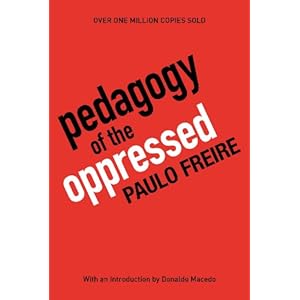
Pedagogy of the Oppressed, 30th Anniversary Edition
Paulo Friere, the patron saint of liberative pedagogy, gives voice to the central problem of humankind, that of “humanization”. For Friere and those who have followed in his wide wake, education is fundamentally about helping the oppressed to become more fully human. Friere’s language for this is frequently focused on empowering the oppressed to become Subjects, escaping the oppressive system in which they are mere objects or reflections of the oppressors. No longer must the oppressed be defined as the antithesis of the oppressors, but as “human in the process of achieving freedom” (49). Friere suggests that in order to “surmount the situation of oppression, people must first critically recognize its causes, so that through transforming action they can create a new situation, one that makes possible the pursuit of a fuller humanity” (47). The process of rising to critical reflection on reality as a human-made, and culture as pliable is known as conscientization.

Book Review: Christian America?: What Evangelicals Really Want by Christian Smith

Some have referred to Christian Smith as a “rock star” among sociologists of Religion due to his prolific and wide-ranging work. Currently serving as the William R. Kenan Jr. Professor of Sociology and Director of the Center for the Study of Religion and Society at the University of Notre Dame, he has recently released titles exploring the nature of the human person (What is a Person?, 2010) and teen and emerging adult spirituality (Soul Searching, 2009 and Souls in Transition, 2010) and has on a forthcoming on evangelical readings of Scripture (The Bible Made Impossible, 2011).  Following up on the landmark American Evangelicalism released in 1998, Smith produced Christian America? drawing on the same body of research that intentionally accessed the thought of common self-identified evangelicals.  

American Evangelicalism: Embattled and Thriving by Christian Smith: Book Review

As the William R. Kenan Jr. Professor of Sociology and Director of the Center for the Study of Religion and Society at the University of Notre Dame, Christian Smith is a notable figure in contemporary Sociology of Religion.  His recent work has explored American Evangelicalism as well as the religious lives of teenagers and emerging adults.  According to his faculty page, his “larger theoretical agenda has been to move culture, morality, and identity to the center of sociological theorizing.”  Released in 1998, American Evangelicalism preceded the increased national and media attention on Evangelicals after they

Book Review: Christian Smith's Moral, Believing Animals: Human Personhood and Culture

Christian Smith is Professor of Sociology and Director of the Center for the Study of Religion and Society at the University of Notre Dame.  He is the author of numerous books including Christian America: What Evangelicals Really Want, Evangelicals: Embattled and Thriving and very recently, Soul Searching: The Religious and Spiritual Lives of American Teenagers and What Is a Person?: Rethinking Humanity, Social Life, and the Moral Good from the Person Up which shares and develops themes from Moral, Believing Animals which was released in 2003.

The seven chapters of Moral, Believing Animals begin by identifying Smith’s agenda as resolving the age-old question of how to describe what it means to be a human.  Smith’s thesis is that

Christianity Rediscovered by Vincent Donovan: Summary & Review


To put words in the mouth of Vincent J. Donovan:  After a futile century of missionary strategies in Africa that centered on purchasing slaves or educating Africans, I felt compelled to pursue a different, more direct approach: to simply go to the Maasai people and talk to them about Christ (13).  I was driven by one conviction:  Christianity is of value to the world and all people have a right to hear it (1, 133).   The Maasai are an elegant, polygamous, cow-herding, monotheistic people nonetheless beset by fears about evil spirits.  When I arrived, I was met repeatedly with the question “If this is why you came, why did you wait so long to bring the message?” 

I began by expressing my belief that the Maasai were very pious already knew about God (20).  From this launching point, I attempted to convey only the essential message of Christianity, removing from it not only the accretions of Western culture (54) but also elements of biblical cultures that would prove a stumbling block such as the agricultural propaganda of the creation

Book Review: The Celtic Way of Evangelism by George Hunter

According to George Hunter III:  The way St. Patrick and those who followed in his legacy went about evangelism has much to teach us today.  Patrick’s experience in slavery among the Celts attuned him to Celtic culture and informed his approach when he returned decades later as missionary bishop.  His strategy included a team that wouldset up camp near a settlement, engage with the local leader, converse with all, pray for the sick and make open-air presentations of the gospel in culturally familiar forms including story, poetry, parable, symbol and drama, all with the goal of planting a church (21).  Church took shape as lay monastic communities that offered a visible place of hospitality free from violence (29).  Celtic Christianity (CC) prized the imminence of God and thus gave attention to the middle-level issues of life and

Evangelism after Christendom: Review and Reflections Pt. 3


According to Bryan Stone:
Evangelism, as a practice of the Spirit, is therefore  utterly pacifist in nature.  The pacifism of evangelism is not passive but arises from an eschatological trust in the Spirit who goes before the evangelist (229).  Apologetics, if an attempt to make faith compulsory on the basis of reason, fail the test of pacifism (232).  Instead, apologetics are primarily an act that seeks to reveal the beauty of holiness.  Thus the primary tasks of evangelism are “confession, proclamation and public exemplification” rather than argument and persuasion (232).  This task occurs in and through

Evangelism after Christendom: Review and Reflections Pt. 2

According to Bryan Stone:
Christian conversion is foremost an exchange of narratives. Two rival narratives have significantly shaped the social, political and economic orders and religious life of Western cultures.  The Constantinian story fuses church and world and calls for ‘realistic’ appraisal of faithful Christian living.  Constantinian-storied evangelism pragmatically values worldly power and is committed to effectiveness, control and success (125).  The second rival, the Story of Modernity, is characterized by the freedom of the individual and the ‘secular’ arenas from the influence of religion.  Modern-storied Evangelism is reduced to “church marketing” (167) and promoting the “usefulness of the gospel for “everyday living” (146).  This is commodification of salvation, and

Evangelism after Christendom: Review and Reflections Pt. 1

If you haven't read Bryan Stone's Evangelism After Christendom: The Theology and Practice of Christian Witness, consider these next three posts a primer to this significant contribution to the theology of evangelism.  

Stone’s overarching thesis is that faithful evangelism is most fundamentally accomplished in the “beauty of holiness made real in the church” (12). Laying the foundation for this thesis, he identifies evangelism as a veritable practice—a virtuous activity whose ends are intrinsic. Moreover, evangelism is a constitutive Christian practice (47); the whole Christian life can be described as evangelism and the absence of evangelism, broadly defined as witness, is effectively the absence of Christianity. Stone asserts that most of what has been written in recent decades on evangelism is misguided due to a focus either on pragmatics or apologetics, both of which are grounded in non-Christian narratives. The primary logic of evangelism is that