Showing posts with label education. Show all posts

PhD Programs in Practical Theology: A List

Since I couldn't find a good list of schools with PhD programs in Practical Theology (US) anywhere on the web, I made my own:

Boston University School of Theology
A PhD in Practical Theology with concentrations in homiletics, liturgical studies, mission, evangelism, mission and evangelism, pastoral theology, spirituality, church and society, congregational studies and religious education.

Emory University
A PhD concentration in Religious Practices and Practical Theology with opportunities to specialize in religious education, pastoral care, homiletics, liturgics, and congregational leadership.  

Garrett-Evangelical Theological Seminary
PhD's in Pastoral Theology and Personality and Culture, Christian Education and Congregational Studies and Liturguical Studies, among others.

Princeton Theological Seminary
PhD in Practical Theology with concentrations in Christian Education, Pastoral Theology, or Homiletics.

Vanderbilt University
Program in Theology and Practice with Fellowships for any area of study: Ethics and Society, Hebrew Bible and Ancient Israel, Historical Studies, History and Critical Theories of Religion, Homiletics and Liturgics, New Testament and Early Christianity, Religion, Psychology, and Culture, and Theological Studies

Luther Seminary
A PhD in Theology with Concentrations in Pastoral Care and Counseling and Congregational Mission and Leadership.

Fuller Theological Seminary
A PhD in Theology with a Concentration in Practical Theology with 4 tracks: (1) The Personality, Theology, and Culture, (2) Evangelism, Discipleship, and Spirituality, (3) The Community, Vocation, and Leadership, and (4) Marriage and Family, Theology, and Practice.

Claremont Lincoln University
A PhD in Practical Theology with two areas of concentration: Education and Formation and  Spiritual Care and Counseling.


St. Thomas University
A PhD in Practical Theology.

Comment to let me know:
Which ones am I missing?
How would you rank these programs?

Video: The Future of Theological Education

JR Rozko, a friend, blogger and co-creator of this video penned these provocative words about the future of theological education:

"to the extent that our current systems of theological education have been shaped by Christendom presuppositions, they have lost their missiological bearings and are wholly inadequate to prepare Kingdom leaders. Incremental changes and clever adaptations to these current systems only serve to distract from the opportunity we have before us to develop a Kingdom, and therefore missional, vision of theological education. At the heart of this vision is the conviction that the proper telos of theological education is an “accreditation” of students based not merely on the degrees they earn, but on the development and fit of their character and competency for life and leadership in the Kingdom of God.""

For a visually compelling expansion along these lines, check out the video he collaborated on, as well.


Re-Imagining Theological Education | 3DM from 3DM on Vimeo.

A Draft Christian Philosophy of Teaching


Education is the enterprise in which teachers and students collaborate toward the student’s formation and development.  The formation which Christian education seeks is holistic, purposing not only to facilitate intellectual development, but also to contribute to the student’s spiritual vitality, growth in virtue, vocational discernment, emotional wholeness, self-awareness, and relational maturity.

Education’s end, however, is not merely the holistic development of individual students, but ultimately—by the grace and action of God— the cultivation of a more just, peaceful and flourishing world.  Thus, the proper horizon of education is eschatological, anticipating the day when whole persons will dwell in renewed human community in a world restored to shalom.  While education draws its telos from this eschatological reality, it—as a human endeavor—cannot ultimately produce that to which it points.  Its role, instead, is to prepare persons and communities as foretastes of the final redemptive work of God, who alone can set the world to rights.             

Formation of the Moral Self by J. van der Ven: Summary

Johannes A. van der Ven’s Formation of the Moral Self arises as a response to the widespread concerns about deterioration of the moral fabric of Western society.  The questions which reveal this instability include: What is good? What is right? What is wise? What is purposive?  Van der Ven’s intention is not to offer definitive resolution to these questions, or to quell the tumult of concern, but to direct this energy into a discussion of the various modes of moral education, their merits and shortcomings, and lift up his preferred approach.

Drawing from Habermas, van der Ven establishes the categories of morality he uses throughout.  Purposive morality is strictly a matter of whether the means employed effect the ends intended.  If so the end justifies the means.  The good is something determined by the individual who makes a judgment about what values and virtues are believed to be appropriate for themselves.  Determining what is right requires consideration of the “life, interests, welfare, or good life of others” (5).  In order to resolve the inevitable conflicts between what is good (for the individual) and what is right (for others) van der Ven looks to

Liberative Pedagogy: Educating for Social Transformation

I can still remember the sights and sounds of Kibera, Nairobi’s largest slum. I had made the trip to Kenya during the Christmas break of my junior year in college and I had been visiting the missionary families of two roommates. Jesse and his mom, who worked for an NGO, knew a family who lived in Kibera, and we were to be their guests. This experience was, on the surface, unremarkable. There were no moments of conflict or fear and no profound utterances on the lips of our hosts, and yet the simplicity of this event was no-less deeply educative. Merely to sit on the blanket-covered dirt floor of this corrugated metal home, to see the posters of Western pop-icons on the wall, to receive a meal and a Coke from those who scarcely had enough to eat themselves was, for me, a new experience of being with those on the underbelly of the world.

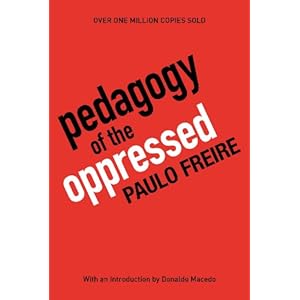
Pedagogy of the Oppressed, 30th Anniversary Edition
Paulo Friere, the patron saint of liberative pedagogy, gives voice to the central problem of humankind, that of “humanization”. For Friere and those who have followed in his wide wake, education is fundamentally about helping the oppressed to become more fully human. Friere’s language for this is frequently focused on empowering the oppressed to become Subjects, escaping the oppressive system in which they are mere objects or reflections of the oppressors. No longer must the oppressed be defined as the antithesis of the oppressors, but as “human in the process of achieving freedom” (49). Friere suggests that in order to “surmount the situation of oppression, people must first critically recognize its causes, so that through transforming action they can create a new situation, one that makes possible the pursuit of a fuller humanity” (47). The process of rising to critical reflection on reality as a human-made, and culture as pliable is known as conscientization.

Being Educated Beyond Our Obedience Pt. 2

More than any other in my short history as a blogger, my recent post "Being Educated Beyond Our Obedience" generated a lot of hits and debate. I responded to this on www.catalystspace.com with this....

Hey Guys,

Wow, quite a lively debate here-though I do think it's gotten of topic quite a bit. I'm the guy who wrote the original post and want to speak to Jesse's question near the top:

"How can we fix this problem? Perhaps more sermons against this? I intuitively believe this is a deeper problem than more teaching will fix - it seems to me that we’ll need some kind of fundamental change in our system."

Jesse -- You've got to be dead right. How absurd of us to think that we can educate (teach) our folks out of being over-taught and inactive. The system is the thing. You look at how Jesus made disciples, teaching was just an element, whereas in most of our churches we depend on the teaching alone. I find that those with teaching gifts (myself included) tend to think that a good sermon can fix anything. It's like we're the guy who's only tool is a hammer and therefore sees every problem as a nail.

What we need is something like Jesus' model of discipleship which is summed up by no better work than "apprenticeship". Jesus' crew became like Jesus because they kept company with him, watched what he did and joined in. Remember Jesus and the 5000? Jesus said "You feed them" to his disciples. Remember the sending out of the 12 and 70? Matthew's Gospel is the best discipleship model I've seen - with a chunk of chapters on what Jesus did, followed by a chunk on the disciples doing the same, and concluding with a commissioning of the disciples to go reproduce "teaching them to OBEY everything I have commanded.'

If there is any steam left in this conversation - I hope someone will spend it on proposing a 'programmatic' solution to being educated beyond our obedience.

Related Posts:
Being Educated Beyond Our Obedience Pt.1
God's Word is Dangerous Entertainment
Confessions of a Glutton

Being Educated Beyond Our Obedience

I wrote a post some time ago about being a glutton for knowledge that I did nothing with. This same idea came into focus when I heard someone quote Niel Cole recently as having described American Christians as "educated beyond their obedience."
When I was growing up I can remember my charismatic church teaching that when God tells you to do something, he waits until you do it before he'll tell you anything else. I don't take this to mean that God only talks to those who obey, but rather that discipleship is done on a "need to know" basis. 

I wonder if we aren't damaging our souls by learning more about God when we haven't acted on what we already have learned. Are we becoming calloused to conviction?

Jesus had some clear teaching for his fans that resisted becoming true followers.

"Everyone who hears these words of mine and does not put them into practice is like a foolish man who built his house on sand...and when the storm comes, the house will fall with a great crash."

The sadly funny thing is we've somehow become convinced that the best way to follow Jesus is to learn something new about God, when in fact, we'd be far better served to act upon one thing we have already "learned." You might say that the almost ignorant activists make better disciples than the learned philosophizers. And this is an indictment of me, as it is likely to be of you - who derive some pleasure from reading a blog about Jesus. :)

An elder at our church who's deeply invested in a ministry planting churches in Africa told me about how they make disciples, using a process they called "obedience based discipleship." While the sound of it is, I'll admit, a bit off-putting this is quite close to what I'm suggesting. It's a cycle of praxis that begins with Bible study: learn, action, reflect. Learn, act, reflect. They've planted thousands of churches and developed as many pastors using this method, and it's about time we learned from the new center of the Christian world.

Let me ask you, what is one thing you have learned about following Jesus that hasn't moved from mind to hand? I dare you, before you learn one more thing, before you listen to one more sermon, do it.


Related Posts:
Being Educated Beyond Our Obedience Pt. 2
God's Word is Dangerous Entertainment
Confessions of a Glutton